

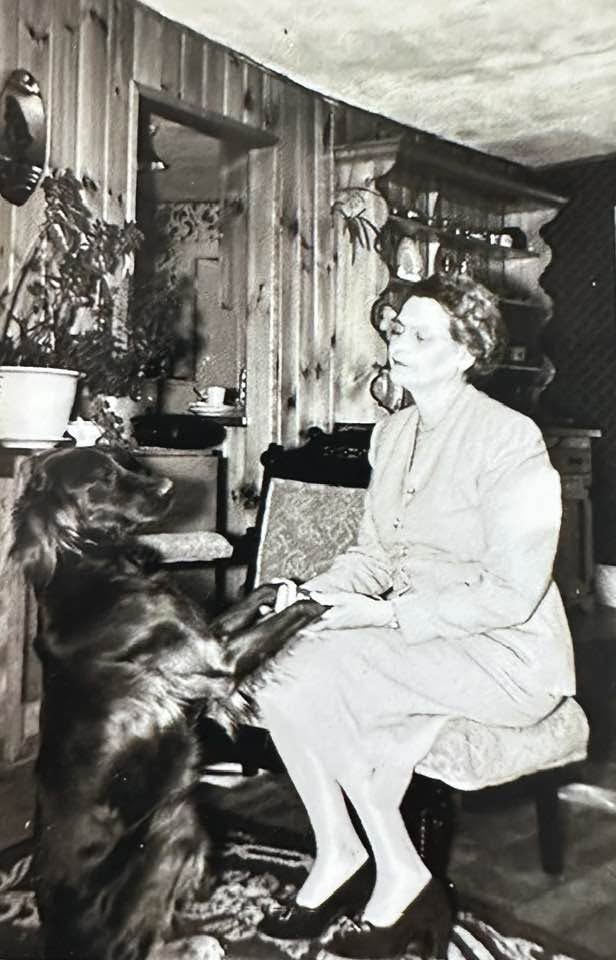
Two courageous women from colonial America, a Vermont grandmother of unwavering faith, and a family history that reaches back to the earliest chapters of our nation.
When people hear the name Fox in connection with the Four Chaplains, they naturally think of Rev. George L. Fox. He was one of four military chaplains who sacrificed their lives aboard the USAT Dorchester on February 3, 1943.
But another remarkable story belongs to George’s wife, Isadore Gertrude Hurlbut Fox (1896–1982).
My research into my grandmother’s ancestry has uncovered some extraordinary connections. Among her ancestors were two women whose courage and religious convictions helped shape early American history: Anne Marbury Hutchinson and Mary Dyer.
Their stories unfolded nearly three centuries before Isadore’s. Yet they reveal a fascinating thread running through our family history: generations of women whose faith and convictions shaped their lives.
Anne Hutchinson: A Woman Who Refused to Be Silenced
Anne Marbury Hutchinson arrived in the Massachusetts Bay Colony in 1634. At that time, Puritan religious leaders held enormous influence over everyday life.
Anne was intelligent, outspoken, and deeply religious. She began hosting gatherings in her home to discuss sermons and religious teachings.
Her meetings attracted considerable attention. In particular, she challenged the interpretations of some of the colony’s most powerful ministers.
Women in colonial Massachusetts rarely challenged male religious authorities. Anne, however, refused to remain silent.
In 1637, colonial authorities put her on trial for challenging their religious teachings. They eventually banished her from Massachusetts.
Rather than abandon her convictions, Anne and her family moved to Rhode Island. There, they joined others who sought greater religious freedom.
Today, Anne Hutchinson stands among the earliest and most important women to challenge religious authority in colonial America.
Mary Dyer: A Woman Willing to Die for Her Beliefs
Mary Dyer was a contemporary and supporter of Anne Hutchinson. Like Anne, she became involved in the religious conflicts of Massachusetts Bay Colony.
Mary eventually embraced the Quaker faith. Quakers believed in spiritual equality and the importance of following one’s conscience.
However, these beliefs challenged the Puritan religious establishment.
Massachusetts authorities viewed Quakers as a threat. They passed harsh laws against them and punished those who continued to enter the colony.
Authorities repeatedly arrested Mary and ordered her to leave Massachusetts.
But Mary refused to abandon her beliefs or her commitment to religious freedom.
On June 1, 1660, Massachusetts authorities executed Mary Dyer on Boston Common for defying the colony’s anti-Quaker laws.
Today, historians recognize her as one of America’s most important early martyrs for religious liberty.
Her courage exposed the harsh consequences of religious intolerance. Her story
also became part of America’s long struggle for freedom of conscience.
Two Extraordinary Women, One Family Connection
What makes these stories especially remarkable to me is that Anne Hutchinson and Mary Dyer were not simply two unrelated women in my grandmother’s family tree. Their families actually came together through marriage.
Mary Dyer’s son, Samuel Dyer, married Anne Hutchinson, the granddaughter of the famous Anne Marbury Hutchinson.
Their daughter, Ann Dyer, married Carew Clarke in Rhode Island in 1694.
Over the following generations, the family line continued through the Clarke, Corey, and Hurlbut families. Eventually, it led to my grandmother, Isadore Hurlbut Fox.
Imagine that connection!
Two women who challenged the religious establishment of seventeenth-century New England became part of the ancestry of a woman whose own life centered on religious faith.
Isadore Hurlbut Fox: Faith and Conviction in Another Century
Isadore was born in Hyde Park, Vermont, in 1896. She grew up in an America very different from the world her colonial ancestors knew.
She married Rev. George L. Fox, a Methodist minister who would later become one of the Four Chaplains.
When George died aboard the Dorchester in 1943, their son was serving in the Marines. Their daughter, Mary Elizabeth, was only 15 years old.
The tragedy changed their lives forever.
My mother showed remarkable strength during that difficult time. At an age when most teenagers are still finding their way, she seemed to grow up overnight. She met the circumstances with maturity and grace.
My grandmother also possessed deeply held religious convictions. I remember how firmly she believed in certain matters of faith and morality.
For example, Isadore believed that drinking alcohol was a sin against God. She did not simply object to drunkenness. She believed that drinking alcohol at all was wrong.
My mother shared that conviction throughout her life.
Their beliefs reflected the Methodist temperance tradition, which encouraged complete abstinence from alcohol as a religious and moral responsibility.
This family memory offers a glimpse into my grandmother’s character. She held strong beliefs and did not compromise them easily.
Of course, Anne Hutchinson, Mary Dyer, and Isadore Fox did not share identical religious views. Their lives, challenges, and beliefs differed greatly.
Nevertheless, faith played a central role in each woman’s life. Each held convictions that she considered deeply important.
And in Isadore’s case, those convictions influenced the next generation of our family.
A Long Line of Strong Women
As the granddaughter of both George and Isadore Fox, I have always said that I come from a long line of strong women.
Discovering Anne Hutchinson and Mary Dyer in my grandmother’s ancestry gives that statement an entirely new meaning.
Anne challenged the religious authorities of colonial Massachusetts. Rather than surrender her beliefs, she faced banishment.
Mary went even further. She willingly faced execution rather than abandon her religious conscience.
Centuries later, their descendant Isadore faced the devastating loss of her husband. Meanwhile, her teenage daughter demonstrated extraordinary strength and resilience.
Each woman faced different challenges. Each lived in a different world. Yet each showed strength in her own way.
I also find another connection especially meaningful.
Two women in our family history struggled for religious freedom. Generations later, Rev. George L. Fox would stand alongside three chaplains of different faiths during the final moments of the Dorchester.
Together, those four men demonstrated the power of faith, unity, and selfless service.
Of course, this discovery represents only a small part of Isadore’s remarkable family history.
Her ancestry also reaches into the earliest colonial settlements, the Revolutionary War era, and the settlement of Vermont. Many more stories await discovery.
But for now, Anne Hutchinson and Mary Dyer have given me a new appreciation for the family history that preceded my grandmother.
I have always believed that I come from a long line of strong women. Now I know just how far back that line goes.
The Rev. George L. Fox Memorial Chapel & Museum in Gilman, Vermont, preserves the legacy of Rev. George L. Fox and the Four Chaplains. We also share the history of the people, families, and communities connected to that legacy.
Learn more at revfoxmemorialchapel.org.
 Previous Post
